Note
Go to the end to download the full example code.
Tree of trees#
This example shows how to plot trees at the leaf of a tree, using the iplotx library. Note that there are a few conceivable ways to do similar things as this in matplotlib and this is just one such approach, using inset axes.
from ete4 import Tree
import matplotlib.pyplot as plt
import iplotx as ipx

tree = Tree(
    "(,((),(((),()),((),()))));",
)
subtree_strings = [
    "((a,b),(c,d));",
    "(a,((b,c),d));",
    "(a,b,c,d);",
    "(a,(b,(c,d)));",
    "(a,b);",
    "(a,(b,c,d));",
]

# Plot the initial tree
fig, ax = plt.subplots(figsize=(8, 5))
art = ipx.tree(
    tree,
    ax=ax,
    aspect=1,
    edge_color="grey",
)

for i, leaf in enumerate(tree.leaves()):
    # Create an axis in the rough proximity
    # and with the rough diemension of a leaf,
    # with some padding
    x, y = art.get_layout().T[leaf].values
    subax = ax.inset_axes(
        (x + 0.1, y - 0.4, 1.2, 0.8),
        transform=ax.transData,
    )

    # For each leaf, make a tree
    subtree = Tree(subtree_strings[i])
    # Plot the tree with dashed lines
    ipx.tree(
        subtree,
        ax=subax,
        edge_linestyle="--",
    )
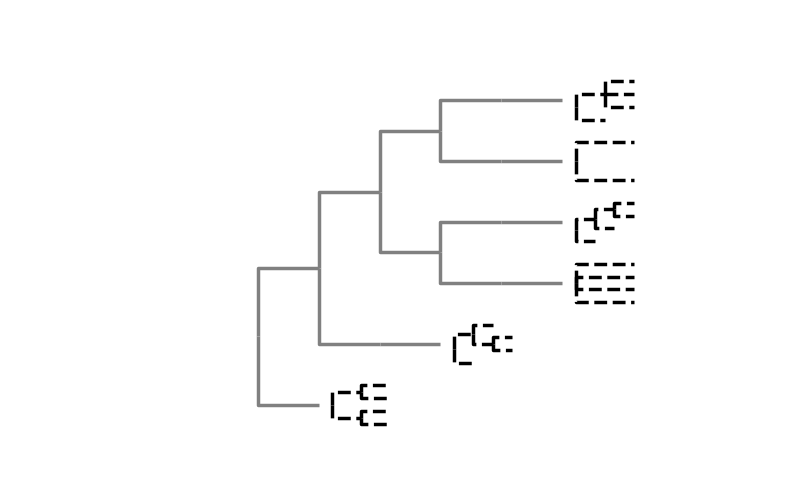
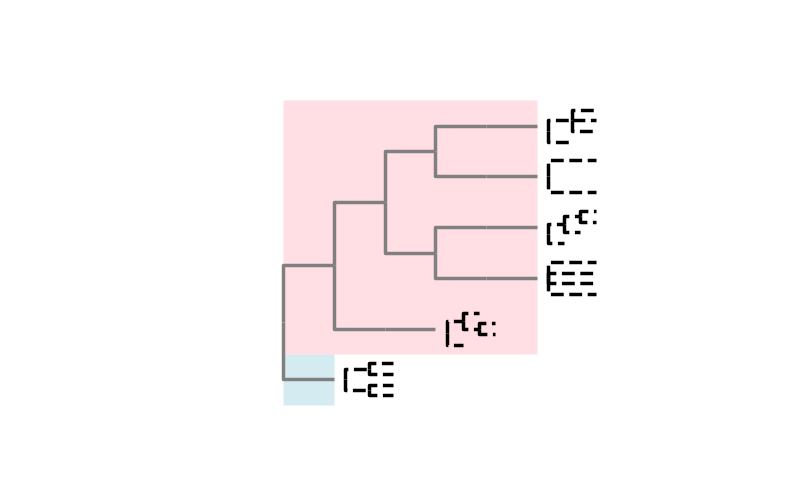
Combining this with other elements, e.g. cascading backgrounds, is possible too:
fig, ax = plt.subplots(figsize=(8, 5))
art = ipx.tree(
    tree,
    ax=ax,
    aspect=1,
    edge_color="grey",
    cascade_facecolor={
        list(tree.leaves())[0]: "lightblue",
        list(tree.traverse("preorder"))[2]: "pink",
    },
)
for i, leaf in enumerate(tree.leaves()):
    x, y = art.get_layout().T[leaf].values
    subax = ax.inset_axes(
        (x + 0.1, y - 0.4, 1.2, 0.8),
        transform=ax.transData,
    )
    # Set the inset axes background transparent
    subax.patch.set_alpha(0)

    subtree = Tree(subtree_strings[i])
    ipx.tree(
        subtree,
        ax=subax,
        edge_linestyle="--",
    )
Total running time of the script: (0 minutes 0.299 seconds)